


How to Create a Cosy Reading Corner in a Small Flat

A reading corner doesn't need its own room. In a small flat, the best ones are usually built from space you already have: the alcove beside the chimney breast, the metre of wall behind the door, the corner the sofa never quite reaches. What makes a nook work isn't size. It's a chair you genuinely want to sit in, light that falls in the right place, and somewhere to put a mug. Get those three things right and a square metre of overlooked floor becomes the best seat in the flat.
Find the space you already have
Before you buy anything, walk around with a tape measure and a critical eye. You're looking for somewhere roughly a metre square — enough for a chair, a small surface and your feet — that isn't on the main route between the kitchen and the bathroom.
Good candidates tend to be:
- An alcove either side of a chimney breast
- The end of a hallway wide enough to take a chair
- A corner beside a window, especially a bay
- The gap between the end of the sofa and the wall
- A bedroom corner under a window, if the radiator isn't directly beneath it
Sit in the spot before you commit. Check three things: can you get in and out without shifting furniture, is there a plug socket within reach, and is it away from the television and the washing machine? A corner facing a blank wall is fine — you're looking at a book, not at the room. A corner beside a draughty front door, or one you have to squeeze past to reach the light switch, is not.
Choose the chair before anything else
The chair sets the size of the corner, the height of everything around it and the mood of the whole thing. Buy it second-hand if you can. Charity furniture shops, Facebook Marketplace, Freecycle and car boot sales are full of solid armchairs that have been outgrown rather than worn out, and a well-made older chair often has a smaller footprint than a modern one.
When you're looking, take your time:
- Sit in it for twenty minutes, not twenty seconds
- Check the frame doesn't rock or creak when you shift your weight
- Make sure the seat depth suits your legs — if the front edge presses behind your knees, it's too deep
- Look for armrests at a height you can comfortably rest your elbows on
- Smell it. Damp, smoke and pet odours are hard to shift
- Measure it, then measure your gap again. Allow about 50cm for your legs
A tub chair, a small wingback, a slipper chair or a plain wooden chair with a decent cushion all work in tight spaces. If there's genuinely no floor left, look upwards instead: a window seat, a deep windowsill with a cushion on top, or a floor cushion propped against the wall.
Two lamps beat one ceiling light
Lighting is what separates a cosy corner from a corner with a chair in it, and a single overhead bulb will not do it. You want two small pools of light rather than one flood.
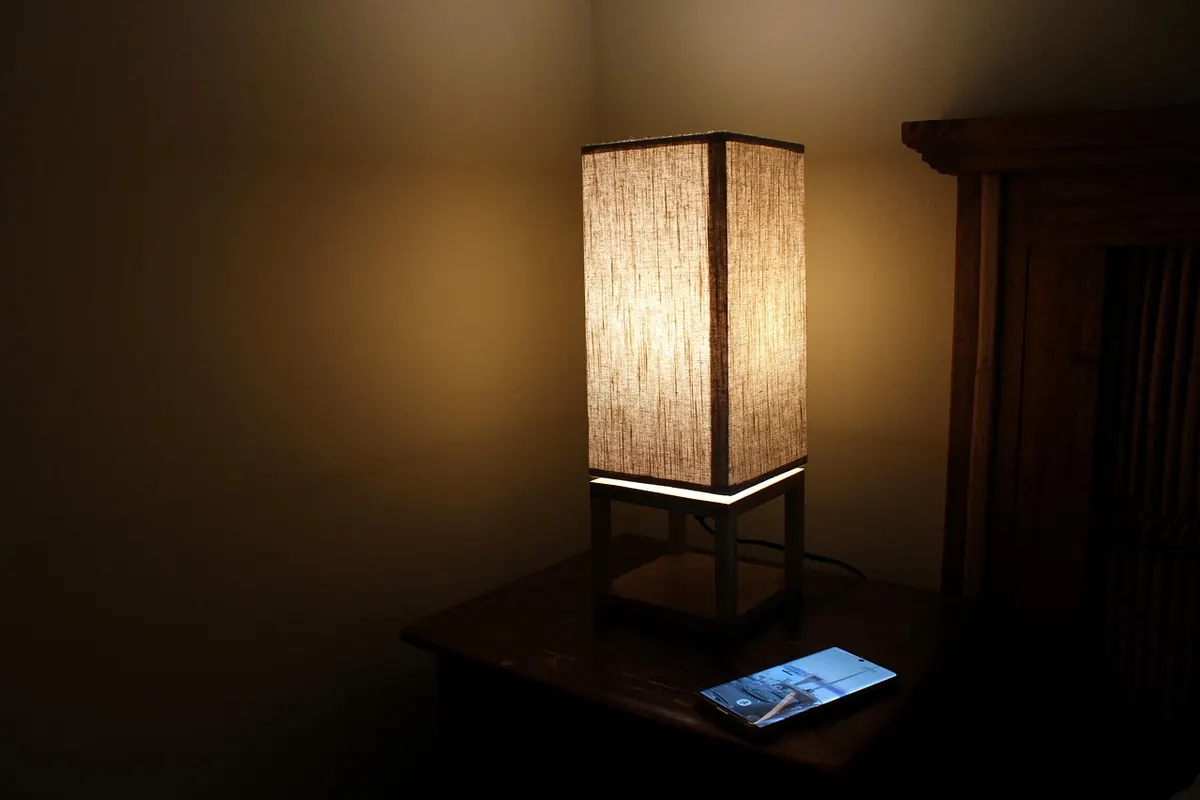
The first goes behind or beside your shoulder — a floor lamp, or a wall light if floor space is tight. The second is a smaller lamp you can move: on a side table, a shelf, or a clip-on attached to the back of the chair. Warm white bulbs make the difference here. Look for ones marked warm white or around 2700K, and keep anything labelled cool white or daylight away from a reading nook.
If you rent and sockets are scarce, you still have options. A rechargeable table lamp needs no cable at all. A plug-in wall light can be fitted without any rewiring. An extension lead can be run behind furniture and tucked into cable trunking, but never across a doorway or a walking route. A dimmer switch or a smart bulb lets you drop the light right down in the evening.
Somewhere to put your mug
You need one flat surface at elbow height. It doesn't have to be a table. A narrow plant stand, a bedside cabinet, a vintage sewing machine table, a wooden stool or a floating shelf all do the job, and all turn up second-hand for very little.
The test is simple: sit down and see where your hand naturally falls. That's the height you want — level with or just below your elbow. If the surface is more than a stretch away, you'll end up putting your drink on the floor, which is how books get ruined.
Keep the surface almost empty. A lamp, a coaster and whatever you're reading. That's it.
Warmth, texture and the five-minute tidy
Small rooms feel calmer when there's something soft to look at. A throw over the back of the chair, a cushion or two, a small rug underfoot and a curtain that reaches the floor all add texture, and they absorb sound as well as softening the edges of a boxy room.
The catch is clutter. A reading corner only stays inviting if it stays tidy, and in a small flat mess spreads fast. Three rules help:
- Keep a basket beside the chair for the throw and anything else that lives there
- Nothing sits on the floor except the furniture
- When something new comes in, something else goes out
Books are the usual culprit. You don't need shelves to have a reading corner. A stack of four or five beside the chair, or a shallow shelf above it, is plenty. Rotate them: keep what you're reading now in the nook and take the rest to a charity shop. If space is tight, your local library will happily hold the overflow for you.
Put it together in an afternoon
This is a single-afternoon job, and it's worth doing in the right order.
- Clear the spot. Vacuum, wipe the skirting boards, take everything out.
- Put the chair in. Sit in it. Nudge it left or right until it feels right.
- Add the lamps and plug them in. Turn the ceiling light off and see how it looks.
- Position the side surface at elbow height.
- Add the throw, cushion and rug last, once everything else is in place.
- Sit there for half an hour with a book and a cup of tea. If you keep reaching for something that isn't there, add it. If something irritates you, take it away.
A good reading corner isn't a decorating project. It's a small piece of your flat that has been given a clear job, and it earns its space the first time you spend a wet Sunday in it.
Photo: stevepb / Pixabay